Water & Foam Fire Monitors —
Manufacturer & Exporter
Complete range of Fixed, Portable, Oscillating, Remote Controlled, High Discharge, and Marine Deck Monitors. Flow rates from 800 LPM to 10,000 LPM. Gunmetal, Bronze, Aluminium, and SS316 construction. Engineered for refineries, tank farms, LNG terminals, and offshore platforms across 26+ countries.
Product Photos
in src=""
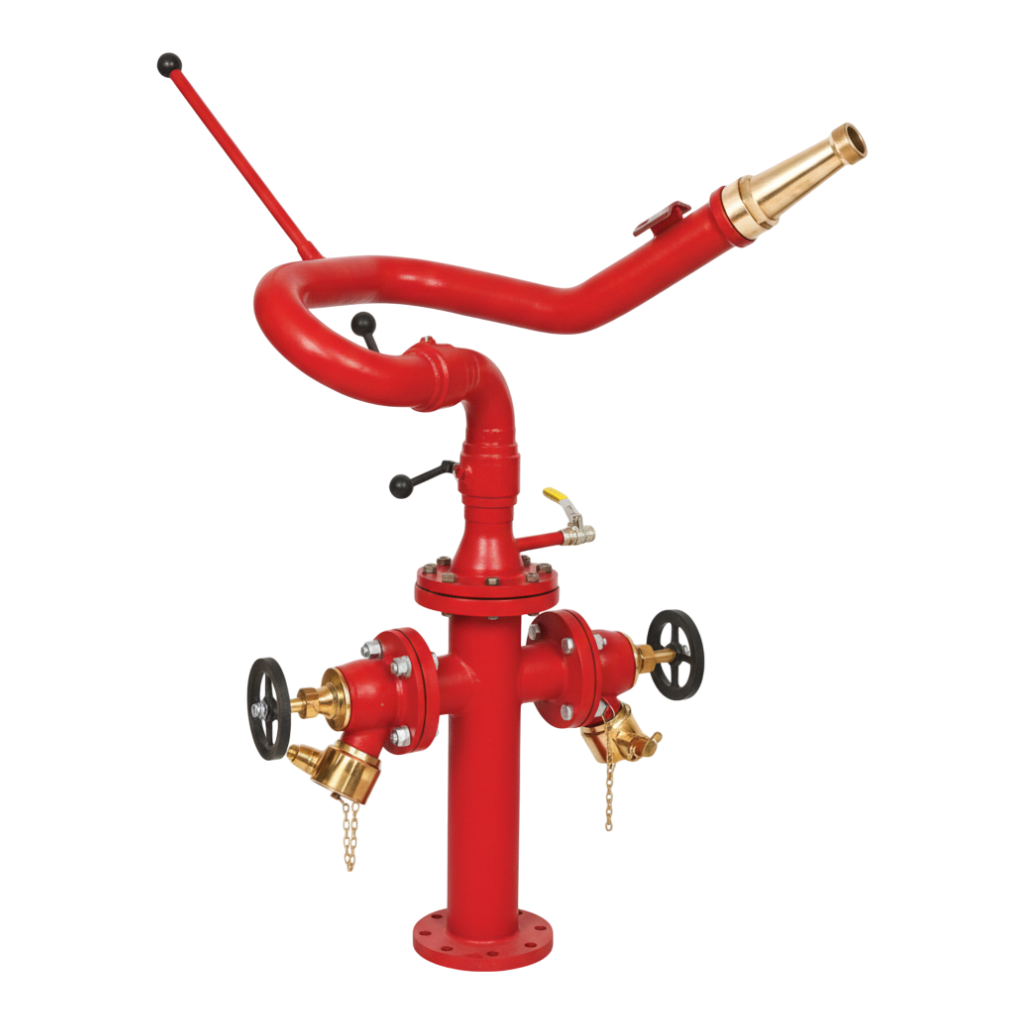
in src=""
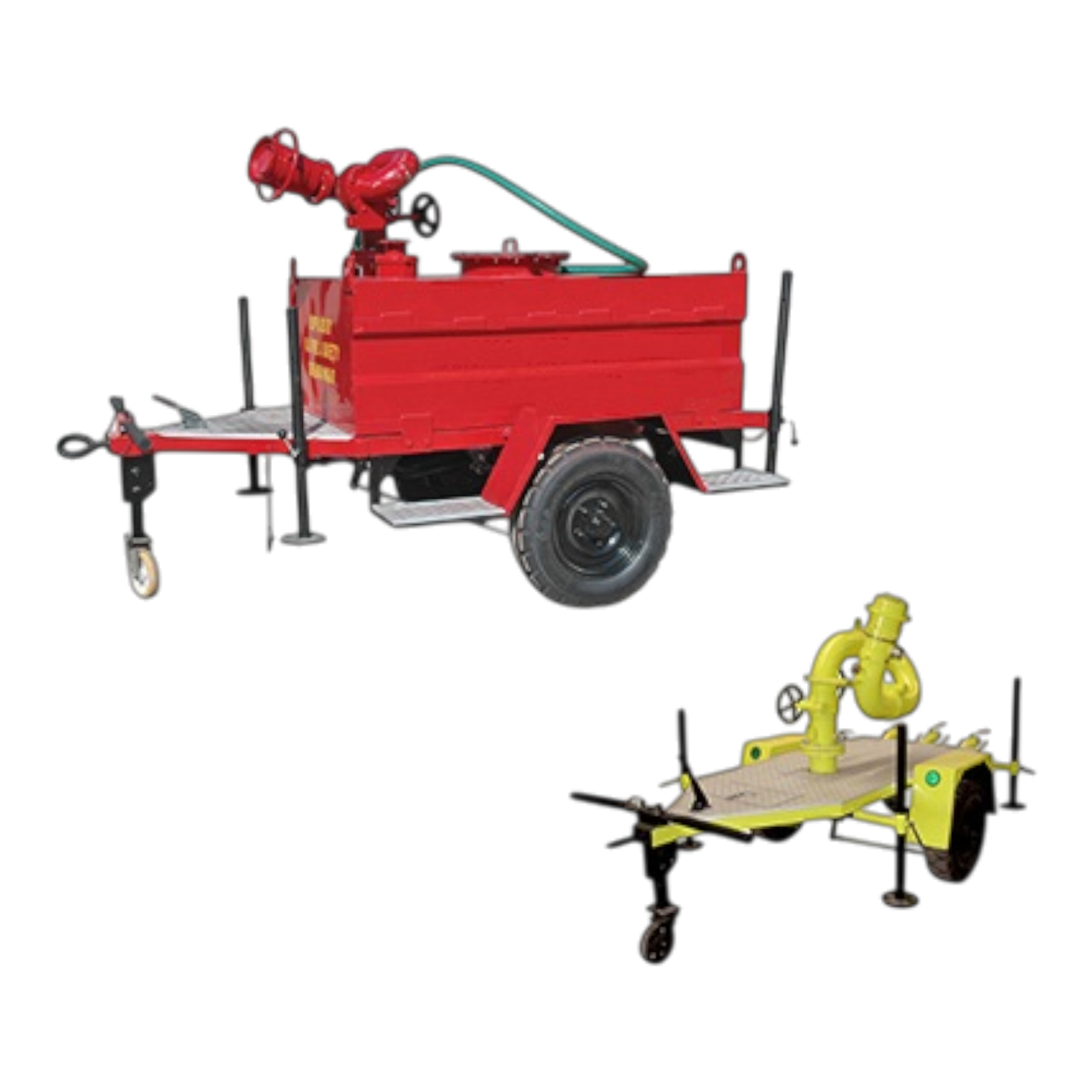
in src=""
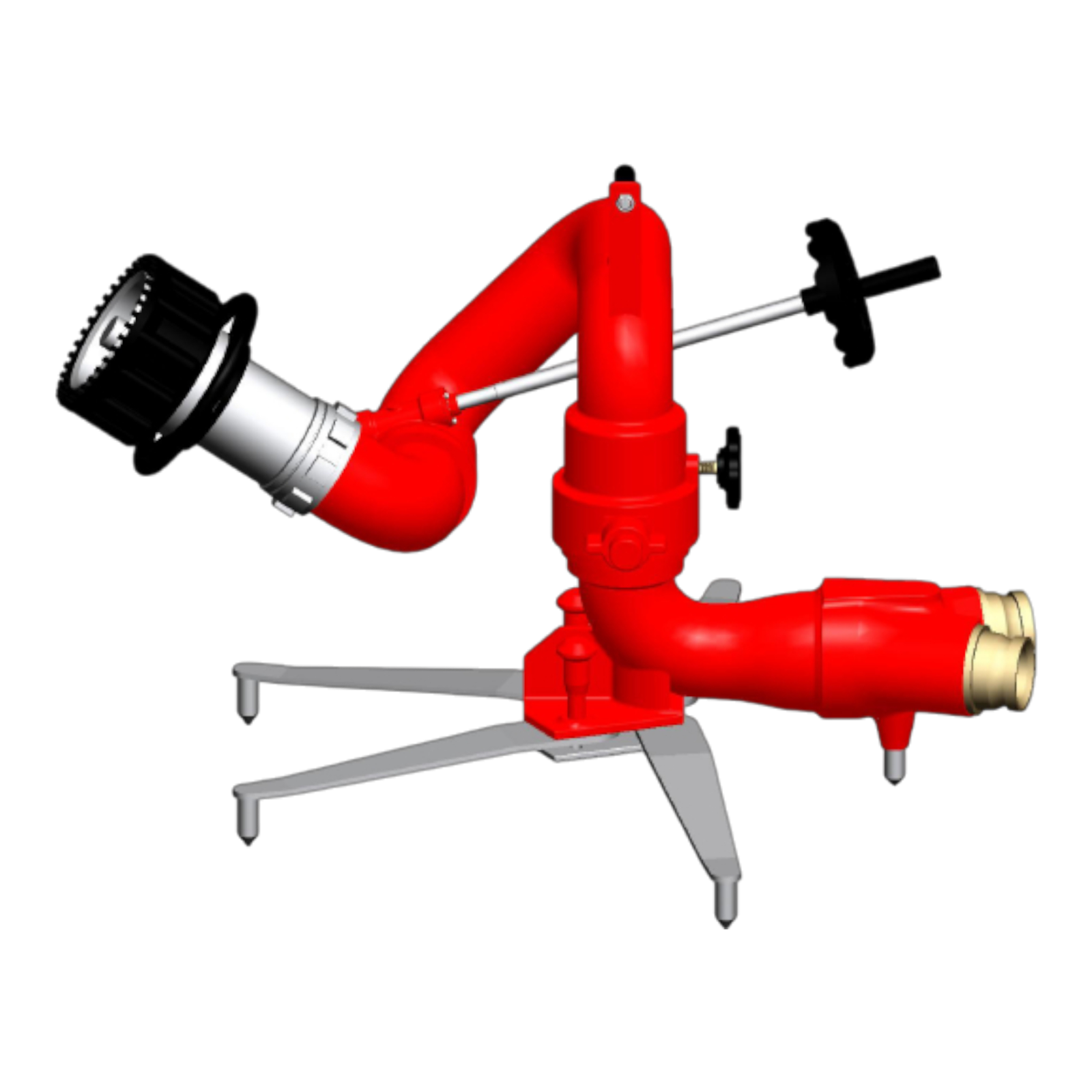
in src=""
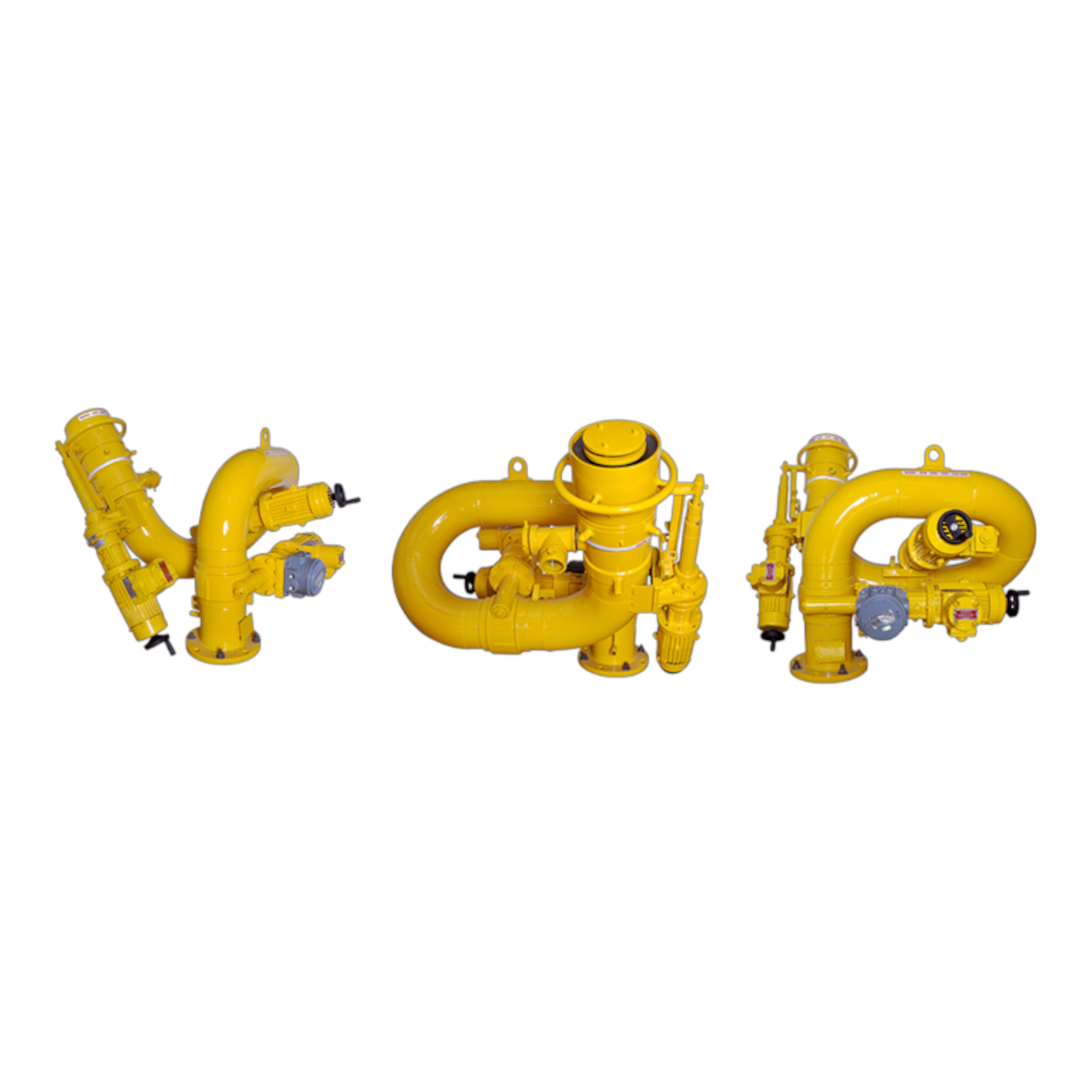
Fire Monitor Range
Six professional-grade monitor types for every application — from manual tank farm protection to fully automated remote-controlled systems for offshore platforms and LNG terminals.

Fixed Fire Monitor (Manual)
Heavy-duty fixed mount monitor with full manual operation. Flanged inlet with 360° horizontal rotation and 135° vertical tilt for precise targeting.
- Flow Rate: 1000 / 2000 / 3000 / 5000 LPM
- Material: Gunmetal / Bronze / SS304
- Operating Pressure: 7–12 Bar
- Inlet: ANSI / DIN Flanged
Portable Fire Monitor (Trolley)
Lightweight monitor on 4-wheel trolley with locking brakes and quick-connect Storz couplings. One-person deployment in under 60 seconds.
- Flow Rate: 800 / 1200 / 1600 LPM
- Material: Aluminium Alloy / Gunmetal
- Weight: 18–35 kg (fully portable)
- Inlet: Storz 65mm / 80mm
Oscillating Fire Monitor (Auto-Sweep)
Hydraulic self-powered oscillating monitor — water turbine driven, no electricity required. Automatically sweeps bund walls, dyke areas, and tank perimeters.
- Flow Rate: 1500 / 2500 / 4000 LPM
- Oscillation: 45° / 90° / 180° adjustable
- Material: Cast Bronze / SS316
- Drive: Self-Powered Hydraulic Turbine
Remote Controlled Monitor (Electric / Hydraulic)
Operated safely from a control room or handheld controller up to 200m away. Includes position feedback, preset target positions, and fail-safe open design.
- Flow Rate: 2000 / 5000 / 8000 / 10000 LPM
- Control: Electric 24VDC or Hydraulic
- Control Distance: Up to 200 metres
- Protection: IP65 / NEMA 4X Rated
High Discharge Monitor (8000–10,000 LPM)
Extra heavy-duty monitor for large-scale industrial fire suppression. Throws water/foam up to 120 metres. Reinforced base with dual operator hand wheels.
- Flow Rate: 8000 / 10,000 LPM
- Throw Distance: 100–120 metres
- Material: Cast Steel / SS316
- Inlet: 6″ or 8″ ANSI Flanged
Deck Monitor (Marine / Offshore Grade)
Full SS316 marine-grade monitor with sealed bearings and IP67 waterproofing. Meets SOLAS, IMO, and MED requirements for vessels and offshore platforms.
- Flow Rate: 1200 / 2400 / 3600 LPM
- Material: SS316 Marine Grade Throughout
- Sealing: IP67 Fully Waterproof
- Approval: SOLAS / IMO / MED
Technical Specifications
Complete flow rate, pressure, throw distance, and material data across all six monitor types — use this to select the right monitor for your site design.
| Monitor Type | Flow Rate (LPM) | Operating Pressure | Throw Distance | H. Rotation | V. Tilt | Material | Inlet Size |
|---|---|---|---|---|---|---|---|
| Fixed Monitor (Manual) | 1850 / 2580 / 3700 / 5500 / 7300 | 7–12 Bar | 50–110 m | 360° | +70° / –20° | As Per Datasheet | 2½″ – 8″ Flanged |
| Portable Monitor (Trolley) | 1750 / 2580 | 5–10 Bar | 50–65 m | 360° | +75° / –10° | As Per Datasheet | Inst. Male 65 / 80mm |
| Oscillating Monitor | 1850 / 2580 | 7–14 Bar | 60–90 m | 45° / 90° / 180° | +60° / –10° | As Per Datasheet | 3″ – 4″ Flanged / 63 mm Male Inst. |
| Remote Controlled | 1850 / 2580 / 3700 / 5500 / 7300 | 8–14 Bar | 50–110 m | 360° | +75° / –15° | As per Datasheet | 3″ – 8″ Flanged |
| Trailer Mounted Monitors | 1850 / 2580 / 3700 / 5500 / 7300 | 7–14 Bar | 50-110 m | 360° | +70° / –20° | As per Datasheet | 6″ – 8″ Flanged |
| Deck Monitor (Marine) | 1850 / 2580 / 3700 / 5500 / 7300 | 7–12 Bar | 50–110 m | 360° | +70° / –10° | SS316 Marine Grade | 2½″ – 4″ Flanged |
| Portable Monitors | 1850 / 2580 | 7–12 Bar | 50–65 m | 360° | +70° / –10° | As per Datasheet | 2 Nos. Male Inst. |
| Nozzle Type | Pattern | Best Application | Water / Foam | Available On |
|---|---|---|---|---|
| Smooth Bore Nozzle | Solid Jet | Maximum throw distance — tank cooling | Water Only | Fixed, Portable, High Discharge |
| Variable Master Stream Nozzle | Jet → Spray & Flow adjustable | Suppression — dual purpose | Water Only | All Types |
| Variable Aqua Foam Nozzle | Jet → Spray & Flow adjustable | Suppression — dual purpose | Water & Foam Both | All Types |
| Single Flow Master Stream Nozzle | Jet → Spray | Class A & Class B Fires | Water Only | Fixed, Oscillating, Remote, High Discharge |
🔧 Material Selection Guide
Gunmetal / Bronze: Standard industrial use, cost-effective. Aluminium: Lightweight portable units. SS304: Corrosion-resistant general use. SS316: Marine, offshore, and chemical plant installations — mandatory for SOLAS applications.
📐 Sizing Formula
Required flow rate (LPM) = Protected Area (m²) × Application Rate (L/min/m²). For tank farm cooling: typically 10 L/min/m² of exposed shell area. For foam application: 4–6.5 L/min/m² based on NFPA 11 risk category. Contact us for a free hydraulic calculation.
🌐 Standards Compliance
All Kinde Fire monitors are designed to conform to NFPA 15 (Water Spray), NFPA 11 (Foam), EN 15182 (European Monitor Standard), and IS 8442 (Indian Standard). SOLAS and IMO compliance for all marine-grade monitors.
Where Are Fire Monitors Used?
Kinde Fire monitors are installed across 10+ critical industry sectors — each with specific flow rate, material, and regulatory requirements.
Oil & Gas Refineries
Tank farm protection, process unit cooling, and loading gantry coverage. Fixed and oscillating monitors on dedicated firewater ring mains.
Fixed / Oscillating / RemoteMarine & Offshore
FPSO vessel decks, offshore drilling platforms, and FSO tankers. SS316 deck monitors meeting SOLAS Chapter II-2 and IMO MSC requirements.
Deck / Remote ControlledLNG & LPG Terminals
High-capacity monitors for LNG import/export terminals, regasification plants, and LPG bullet tank farms. Foam-capable nozzles for hydrocarbon fires.
High Discharge / RemoteAirports & Aviation
Aircraft rescue and firefighting (ARFF) support monitors at fuel farms, hangar aprons, and fuel hydrant systems. Rapid-deploy portable units for ARFF vehicles.
Portable / FixedPorts & Jetties
Berth protection monitors for oil tanker loading/unloading points. Flanged pedestal-mounted fixed monitors on jetty structures meeting port authority codes.
Fixed / Deck MonitorPower Plants
Transformer yard protection, turbine hall coverage, and coal/fuel oil storage area monitors. Oscillating systems for unmanned transformer bay automatic protection.
Oscillating / FixedPetrochemical Plants
Continuous process protection for cracker units, distillation columns, and chemical storage tanks. Remote-controlled monitors for safe operation from blast-protected control rooms.
Remote / High DischargeMining & Minerals
Surface mine haul road dust suppression and fire suppression monitors for conveyor galleries, crusher buildings, and fuel storage areas in South Africa, Zambia, and Zimbabwe.
Fixed / PortableRail & Infrastructure
Fixed monitors at fuel depots, loco maintenance sheds, and rail tanker loading gantries. Portable monitors for rapid-response railway emergency teams.
Fixed / PortableEPC & Construction
Bulk supply of temporary fire monitors for major EPC projects across UAE, Saudi Arabia, Qatar, and Africa — supplied with full compliance documentation for project engineers.
All Types AvailableFertilizer & Agro
Ammonia and fertilizer plant protection monitors — corrosion-resistant SS316 construction for aggressive chemical environments in Nigeria, Egypt, and India.
Fixed SS316Civil Defence & Military
Portable and vehicle-mounted monitors for civil defence departments, military base fire brigades, and government emergency response units across Gulf and Africa.
Portable / Fixed🏜️ Middle East & GCC — Refinery & Civil Defence
6 Countries🌍 Africa — Ports, Petrochemical & Mining
6 Countries🌏 Asia Pacific — Marine, Refinery & Industrial
6 Countries🎯 Need Monitors for a Specific Industry or Country Standard?
Share your flow rate, site type, and compliance requirement — we'll size the correct monitor and provide full documentation within 4 hours.
Troubleshooting & FAQ
18 real-world questions on monitor rotation, foam performance, oscillation, remote control faults, corrosion, and maintenance — tagged by product type and geography.
🔄 Operation & Rotation Problems
4 QuestionsRoot Cause: Grit, sand, or salt deposits infiltrating the horizontal swivel bearing is the most common cause in Gulf and coastal installations. After 12–18 months without maintenance, a mixture of fine desert sand and oxidised grease forms a paste in the bearing race that dramatically increases rotation torque. In cold climates, grease can also congeal in winter causing the same stiffness.
Fix: Shut off water supply and relieve line pressure before starting. Remove the swivel bearing inspection plug (usually a grub screw on the lower body). Flush the bearing race thoroughly with a petroleum-based solvent (WD-40 or equivalent) to dissolve old grease and dislodge grit. Repack with fresh marine-grade lithium complex grease rated for your operating temperature. For Gulf installations, schedule this as a quarterly maintenance task — not annual — due to sand infiltration rates. If the bearing race itself is scored or pitted, the swivel assembly will need replacement; contact Kinde Fire for spares.
Root Cause: Nozzle vibration at specific flow rates is a classic sign of hydraulic resonance — the flow velocity through the nozzle tip matches the natural frequency of the nozzle/monitor assembly. It can also be caused by a partially blocked nozzle creating turbulent flow, or by a loose nozzle tip that is not fully threaded home.
Fix: First, check and tighten the nozzle tip connection — it should be fully seated with no movement. If vibration persists, vary the flow rate slightly (±10%) by adjusting the upstream isolation valve — this shifts the operating point away from the resonant frequency. If a blockage is suspected, remove the nozzle tip and inspect for scale, weld spatter from pipework, or debris. Install a Y-strainer upstream of the monitor (minimum 40-mesh screen) to prevent debris ingestion. For new installations on old piping systems, always flush the system before commissioning monitors.
Root Cause: Rated throw distance is measured at the specified design flow rate and pressure (typically at 30–45° elevation angle in still air). Short throw distance in the field is almost always caused by: (1) insufficient inlet pressure due to undersized supply pipework or inadequate pump head; (2) incorrect nozzle tip size installed — a larger tip than specified reduces velocity; (3) spray pattern set to wide-angle instead of solid jet; or (4) partial blockage in the nozzle or upstream strainer.
Fix: Measure actual inlet pressure at the monitor base flange under full flow conditions using a gauge — compare to the design operating pressure. If pressure is low, check the supply line size (velocity should not exceed 3 m/s in supply mains), pump performance curve, and pressure losses in the ring main. Confirm the correct nozzle tip bore is installed per the data sheet. Set nozzle pattern to full jet (not spray) for throw distance verification. Clean or replace the upstream Y-strainer. Kinde Fire can provide a hydraulic calculation review if you share your pump data and pipe sizing.
Root Cause: The vertical tilt joint uses an O-ring or chevron packing seal that wears over time, especially in systems that experience frequent pressure cycles (daily testing) or where water has high chlorine content (municipal supply) which accelerates EPDM seal degradation. UV exposure also degrades exposed seals on outdoor monitors.
Fix: Depressurise the system completely before working on the joint. Remove the tilt locking bolt, slide out the tilt barrel, and replace the O-ring or chevron pack with the correct size seal — use EPDM for water service, or Viton for foam solution service. Apply silicone grease to the new seal before assembly. Do not use petroleum-based grease on EPDM seals — it causes swelling and premature failure. If the tilt barrel bore is scored, the entire tilt assembly will need replacement. Contact Kinde Fire for the correct seal kit for your monitor model.
🧯 Foam Performance & Application
3 QuestionsRoot Cause: Watery foam with poor expansion is almost always a proportioning issue — the foam concentrate is either not being inducted at the correct concentration (typically 3% or 6%) or the proportioner (inline inductor or bladder tank proportioner) is undersized for the current flow rate. Running the monitor at a higher flow rate than the proportioner's rated capacity will dilute the foam solution below the required concentration.
Fix: Verify the proportioner is sized to match the monitor's design flow rate — not the maximum possible flow rate of the supply main. Check the foam concentrate pick-up pipe and metering orifice for blockages (crystallised concentrate is a common cause after long periods of inactivity). Confirm the foam concentrate type and age — AFFF has a shelf life of 10–25 years; AR-AFFF can degrade faster in high-temperature storage. Conduct a foam sample test: collect a sample and measure expansion ratio and 25% drainage time to NFPA 11 requirements. If proportioning is confirmed correct, check the nozzle type — a smooth bore nozzle will not generate foam; a dedicated foam-making nozzle with air induction ports is required.
Answer: Kinde Fire monitors can be supplied with a dual-purpose water/foam nozzle as standard, or the smooth bore nozzle can be swapped for a foam-making branch nozzle in the field. The nozzle connects to the monitor barrel via a standard 2½″ NH or BSP thread — no tools are required beyond a strap wrench.
To convert to foam: (1) Replace the smooth bore nozzle with the foam-making nozzle. (2) Connect the foam concentrate line from your inline inductor to the monitor supply line upstream of the monitor base valve. (3) Set the inductor metering orifice to 3% or 6% as per your concentrate type. (4) Open the monitor valve and verify foam quality before committing to firefighting operation. For permanent dual-use installations, specify a water/foam combination nozzle with integral selector at time of order — this eliminates the need for nozzle changes during an emergency.
Standard concentrations per NFPA 11: AFFF 3×3 (3% concentration on hydrocarbon) — most common for refinery tank farms. AFFF 6×6 (6% concentration on hydrocarbon) — used where 3% AFFF is not available or for specific risk profiles. AR-AFFF 3×3 or 6×6 — required for polar solvent (alcohol-containing) fuels such as ethanol blended fuels, IPA, and acetone.
Application rate: NFPA 11 requires a minimum of 6.5 L/min/m² for fixed roof tanks and 12.2 L/min/m² for floating roof tanks (rim seal fires) when using Type II foam application (subsurface or semi-subsurface). For monitor (surface) application, NFPA 11 requires 6.1–8.2 L/min/m² depending on risk category. Always confirm with your fire protection consultant and local Civil Defence authority — Saudi Aramco and ADNOC have their own supplementary application rate requirements that are typically more conservative than NFPA minimums.
🔁 Oscillating Monitor Problems
3 QuestionsRoot Cause: The hydraulic turbine oscillating mechanism uses a small water-powered turbine and a cam-and-pawl reversal mechanism to switch the sweep direction at each end of the arc. If the monitor stops at one end, the most common cause is: (1) a jammed or worn reversal pawl; (2) scale or debris blocking the turbine water ports; or (3) the end-stop adjustment screw has vibrated out of position and is preventing reversal.
Fix: Shut off and depressurise. Remove the oscillation drive cover (usually 4 bolts on the side of the monitor body). Inspect the reversal pawl and ratchet mechanism — clean with solvent and lubricate lightly with silicone grease. Check the turbine water inlet ports for scale or debris and clear with a wire probe. Re-set the end-stop adjustment screws symmetrically to the desired sweep angle (typically marked at 45°/90°/180° positions). Reassemble, pressurise, and confirm sweep operation before leaving the site. If the turbine rotor itself is damaged or corroded, the oscillation unit will need full replacement — contact Kinde Fire for spares.
Root Cause: Oscillation speed is directly governed by the flow rate through the hydraulic turbine — higher flow rate = faster sweep. If the inlet pressure or flow rate is above the design point (which happens when upstream isolation valves are fully open on high-pressure systems), the turbine spins too fast and the sweep becomes ineffective for fire suppression purposes.
Fix: Install a flow control orifice plate or needle valve on the turbine bypass port to reduce turbine drive flow while maintaining full monitor discharge flow. Kinde Fire oscillating monitors have an adjustable turbine flow regulating screw on the oscillation body — turn clockwise to reduce speed. The ideal sweep rate for tank cooling and bund protection is 1 full cycle (both directions) every 30–60 seconds — this gives adequate dwell time on each area. Refer to the monitor data sheet for the relationship between inlet pressure and sweep speed for your specific model.
Answer: Yes — all Kinde Fire oscillating monitors include a manual override lock lever that disengages the oscillation drive and locks the monitor in any chosen fixed position. This is essential for precision targeting during foam application on a specific tank or spill area, where sweeping would reduce foam blanket effectiveness.
To lock: rotate the oscillation bypass selector to the "LOCK / MANUAL" position (marked on the body). The monitor will stop sweeping and remain stationary. The manual hand wheel can then be used to aim precisely. To resume auto-oscillation: return the selector to "AUTO" — the monitor will resume sweeping from its current position. This dual-mode capability is standard on all Kinde Fire oscillating monitors and is one of the key features to confirm when procuring from any supplier.
🕹️ Remote Controlled Monitor Faults
3 QuestionsFault Diagnosis (Electric 24VDC systems): Step 1 — Verify 24VDC supply voltage at the control panel terminals under load (not open circuit). A voltage drop below 20VDC under load indicates an undersized supply cable. Step 2 — Check the cable gland entry at the monitor junction box for water ingress — moisture inside the J-box is the most common failure cause in outdoor installations and will cause all axes to fail simultaneously. Step 3 — Verify the E-stop (emergency stop) circuit is not activated — most systems have a local E-stop mushroom button at the monitor base that kills all drive signals when pressed.
Fix: Dry out the junction box completely with a heat gun and re-seal all cable gland entries with silicone sealant. Replace any corroded terminal blocks. Apply conformal coating to the PCB if present. Upgrade cable glands to IP68 rated for any outdoor or coastal installation. If the drive motor itself has failed (confirmed by measuring resistance across motor terminals — open circuit = winding failure), contact Kinde Fire for a motor replacement unit. Always keep the junction box oriented with cable entries facing downward to prevent water pooling at gland entries.
Root Cause: Movement in one direction only almost always indicates a faulty limit switch or position sensor. Each axis has two limit switches at the end of travel — if the switch that stops movement in one direction short-circuits or welds closed, the control system perceives the monitor as already at its limit in that direction and refuses to drive it further.
Fix: Identify the limit switch assembly for the affected axis (usually a micro-switch or Hall effect sensor mounted on the rotation gear). Check for physical damage, corrosion on the switch contacts, or a jammed actuating cam. Replace the defective limit switch with an identical rated unit (IP65 minimum for outdoor use). If the control system uses Hall effect sensors, check the sensor-to-magnet gap — it should be 2–4mm typically. After replacement, verify full-travel operation and confirm limit switches arrest movement correctly at both ends of travel before returning to service.
Root Cause: Hydraulic drive monitors use a hydraulic oil-powered actuator system. Standard hydraulic oil (ISO VG 46) has a viscosity index that causes it to become very thick below 0°C, dramatically slowing actuator response. This is a known limitation in cold-climate installations (Northern Europe, Canada, high-altitude sites in Central Asia).
Fix: Drain and replace the hydraulic fluid with a low-temperature rated hydraulic oil — ISO VG 15 HVI (High Viscosity Index) which maintains fluidity down to –35°C. If the hydraulic power unit (HPU) is outdoors, fit a thermostatically controlled immersion heater in the HPU reservoir to maintain oil temperature above 5°C during cold periods. Ensure hydraulic hose and fitting insulation lagging is intact — exposed hydraulic lines lose heat rapidly in cold conditions and can locally congeal even if the HPU reservoir is warm. Contact us to confirm the correct cold-climate oil specification for your monitor model.
🌊 Corrosion & Material Degradation
3 QuestionsRoot Cause: Green deposits on gunmetal or bronze are verdigris — a natural patina of copper carbonate that forms on copper alloy surfaces exposed to moisture, CO₂, and oxygen. This is entirely a surface phenomenon and is not structural corrosion. In fact, a stable verdigris layer acts as a protective barrier that slows further corrosion of the base metal. It does not affect pressure integrity or flow performance.
When to act: Normal patina — leave it in place; it is protective. However, if you see powdery, soft, or flaking green deposits (dezincification) rather than a hard stable layer, this indicates selective leaching of zinc from the brass/bronze alloy, which does weaken the metal. Dezincification is more common with low-quality yellow brass (high zinc) monitors exposed to aggressive water chemistry. Kinde Fire gunmetal monitors use LG2 or LG4 specification gunmetal (low zinc) which is highly resistant to dezincification. If soft powdery deposits are present, send a sample for metallurgical analysis and consider upgrading to SS316 for the affected installation.
Root Cause: Carbon steel flange bolts in coastal and offshore environments corrode and seize within 2–5 years due to galvanic interaction between the steel bolt and the bronze/SS monitor body — dissimilar metal corrosion creates an oxide bond that welds the bolt to the flange nut. This is one of the most common maintenance problems reported from Mombasa, Lagos, and offshore Gulf installations.
Removal: Apply a penetrating oil (Kroil or Plusgas) generously around the bolt head and nut — wait 24 hours minimum. Use impact wrench rather than torque — impact action breaks oxide bonds more effectively than steady torque. If the bolt shears, use a bolt extractor set. If the bolt is completely fused, controlled use of an angle grinder on the nut may be necessary — exercise extreme care near flanges. Prevention going forward: Replace all flange bolts with A4-316 stainless steel bolts with anti-seize compound (Molykote or copper-slip) applied to threads and under bolt head before assembly. Re-torque to the correct specification annually. This is mandatory for any installation within 5km of the coast.
Municipal water (chlorine <2 ppm): Bronze or Gunmetal monitors are fully suitable. Standard specification for most industrial sites using municipal or treated bore water supply. High chlorine supply (2–5 ppm, as in some Gulf desalinated water systems): Gunmetal LG2 with Viton internal seals — avoid EPDM seals which degrade above 2 ppm chlorine. Seawater firefighting systems (offshore, jetty firewater drawn from sea): SS316 is the only correct choice — bronze alloys suffer accelerated corrosion from the combined effect of seawater chlorides and biofouling organisms. Gunmetal is not suitable for continuous seawater service. Always specify water chemistry (pH, chloride content, chlorine residual) when requesting a monitor quotation — this determines seal material selection as well as body material.
🔧 Maintenance & Inspection
2 QuestionsWeekly (unmanned systems / critical risk): Remote visual check — confirm no visible leaks, damage, or obstruction of monitor arc. For remote-controlled monitors, confirm control panel power is live and no fault indicators are showing.
Monthly: Manual operation check — rotate fully in both horizontal axes and confirm smooth movement throughout full arc. Check nozzle tip for blockage or damage. Inspect flange bolts and tighten if loose. Visually inspect for corrosion on body, bolts, and nozzle. Confirm no water weeping from swivel seals.
Quarterly (Gulf / Coastal): Re-grease all swivel bearings with marine-grade lithium grease. Inspect and clean the upstream Y-strainer. Verify nozzle discharge pattern with a short flow test. Inspect electrical connections on remote-controlled units for moisture ingress.
Annually: Full flow test at design pressure — confirm flow rate, throw distance, and pattern per original specification. Replace all O-ring and packing seals as a preventive measure. Inspect oscillation mechanism and regrease. Pressure test to 1.5× working pressure. Update maintenance log and inspection tag. Document in the facility fire protection maintenance register per NFPA 25.
Do not pressurise without completing these checks first:
Step 1 — External inspection: Check body, nozzle, and flange for visible corrosion pitting, cracks, or physical damage. Attempt manual rotation before pressurising — if the swivel is completely seized, pressurise will force rotation and can damage internal seals. Step 2 — Strip and inspect seals: After 3+ years, all O-rings and packing seals will be compression-set and will leak on first pressurisation. Replace all seals as a matter of course — do not attempt to reuse. Step 3 — Flush supply pipework: After years of stagnation, the supply pipe will contain significant scale, biological growth, and sediment. Flush the supply line to drain before connecting to the monitor. Step 4 — Low-pressure test first: Pressurise to 2 Bar only for 10 minutes and check all joints and seals before stepping up to full working pressure. Step 5 — Full-flow test: Conduct a full operational test at design flow rate and pressure. Record throw distance and pattern — compare to original commissioning data. Contact Kinde Fire for a recommissioning checklist specific to your monitor model and size.
🎯 Need Help with a Specific Monitor Problem?
Our technical team responds within 4 hours — WhatsApp or Email for fastest response.
Ready to Source Industrial-Grade
Fire Monitors for Your Project?
Share your flow rate, site type, and compliance requirement — we'll confirm the correct monitor type, material grade, nozzle configuration, and price within 4 hours. Exporting to 26+ countries with full documentation.
🎯 Monitor Types Available
- Fixed Monitor — 1000–5000 LPM
- Portable Trolley — 800–1600 LPM
- Oscillating (Auto-Sweep) — up to 4000 LPM
- Remote Controlled — up to 10,000 LPM
- High Discharge — 8000–10,000 LPM
- Deck Monitor (Marine) — SOLAS Grade
🔩 Materials & Grades
- Gunmetal LG2 / LG4 — Standard Industrial
- Aluminium Alloy — Lightweight Portable
- Bronze — General Industrial
- SS304 — Corrosion Resistant
- SS316 — Marine / Offshore / Chemical
- Cast Steel — High Discharge Heavy Duty
📋 Documents & Certifications
- Material Test Certificate (MTC)
- Factory Hydraulic Test Report
- NFPA 11 / NFPA 15 Compliance Decl.
- SOLAS / IMO Cert (Marine Grade)
- Dimensional GA Drawing
- Aramco / ADNOC Datasheet Format